Concrete Sealer Types
Out of all the thousands of concrete sealers available in the market – how do you determine the correct sealer for your personal concrete project?
- Determine what you want to seal and protect such as concrete, clay brick, cinder block, and concrete pavers, natural stones, decorative concrete, stamped concrete, epoxy stones, expose aggregate.
- Define the final look that you are expecting to see after sealer application.
- Determine how often you will need to re-seal the area.
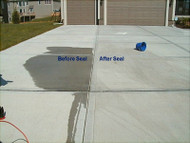
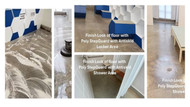
After application, it is a good idea to test the sealer. When testing a sealer, pour water over the surface 24 hours after the application has been performed. If the concrete does not immediately change color , the sealer is working if the concrete changes color immediately the sealer is not working correctly. (Picture) Water bidding on the surface of the concrete is and old method to determine if the concrete was seal or not. Color change is what the construction industry uses today, not all sealers bid water on the surface.
There are only about six different types of concrete sealers which are determined by the technologies that are used. Each of these sealers has advantages and disadvantages. We will attempt to clarify these. The first thing you need to know when selecting a concrete sealer is which category it falls. The first three sealers are penetrating sealers. The last three are topical sealers, which can also known as surface sealers.
Penetrating Sealers
Silane Concrete Sealers
Silanes penetrate the concrete well and do a fairly good job of sealing the concrete. The concrete must be thoroughly saturated with a high solid Silane to be adequately sealed. The main problem in the industry is that the products are used with too low of a spread ratio and are generally do not have high solid (active ingredient) content. These are both ways to save money on the product and increase the installer’s profit margin. Ideally, up to three saturations of the concrete are needed to achieve an adequate seal.
Silanes have other serious disadvantages. 1) If they are spread to thinly, the hydrocarbon chain (organic compounds) can remain active in the concrete. This means that if any other hydrocarbon such as oil, gasoline, diesel fuel, etc. is spilled on the concrete – a PERMANENT stain is attached to the open hydrocarbon chain. The only way to remove this stain is to remove the concrete. 2) Total saturation required for an adequate seal will darken the concrete. 3) If applied properly (with thorough saturation and high solids), Silanes are very costly. 4) Silanes are slow to react so they tend to move further into the substrate leaving the surface exposed. This is why minimum of two applications are recommended for a good seal.
Siloxanes are the new technology in Silane sealers which are a modified version of the Silane sealer. The primary advantage is that it was designed to seal new or old surfaces such as concrete blocks, exposed aggregate, cinder blocks, clay bricks and natural stones or very pours surfaces. The treated material has little or no color change and it protects for a longer period of time. Sealing correctly with Siloxane requires two applications to saturate material correctly.

Silicate Concrete Sealers
These are chemically reactive, penetrating concrete sealers that permanently bind to the silicates in the concrete. The concrete must be removed in order to remove the sealer. However, silicates are easy and inexpensive to make. There is no standard and the quality of the sealer is very dependent on the manufacturer and their ethics. In addition, silicates have very small molecules and as such go very deep into the concrete. Therefore, in order to get a topical seal, you must build the sealer from the bottom of the concrete to the top. This requires a lot of product and many applications – sometimes even working the product into the concrete. Most installers do not apply the product properly so an adequate seal is not achieved. Silicate sealers are the lower price sealers of the penetrating sealers and the life of the sealer is short.
Siliconate Sealers
Like silicate sealers, these sealers work by creating a permanent chemical change in the concrete, forming a new, sealed chemistry. Siliconates have larger molecules and offer more surface protection. Siliconates are fast reactive when they meet the concrete therefore remaining at the top of the substrate. Siliconate sealers are the perfect choice when your primary objectives are reducing moisture absorption, reducing freeze/thaw damage and stain penetration. Siliconates dry within the concrete, thereby not changing the appearance or the texture of the concrete surface. They can also be used as a cure for freshly poured concrete. They cure by retarding moisture but still allow the concrete to breath. Siliconates have multiple applications – they can be used on bare concrete walls or stucco to keep moisture from soaking through paint and to allow the paint to last longer. Siliconates can be used on sidewalks, driveways, parking lots, etc. to reduce cracking, staining, and freeze/thaw damage. Overall, this is the sealer we believe works the best for the majority of applications on broom finish or trowel finish concrete.

Topical Sealers (Surface Sealers)
Silicone Concrete Sealers
These sealers have very high water and oil repellant properties. However, silicones have a very short life, are UV unstable (they break down more rapidly in bright light), and are a surface sealer and not hold up well to wear and tear. If you use a silicone sealer, you need to reapply it frequently to maintain its protective properties (can be as often as every few months when exposed to the sun). (Siloxane – a variation of silicone)
Acrylic Sealers
These sealers are widely used in the industry and are primarily solvent-based products. These sealers can become brittle and delaminate with age. They also have a tendency to turn yellow in the light. These come in a variety of solids (the higher the solids, the longer the sealer will last), some come with UV protection, and they even come in a water-based formulation. The solvent-based formulas emit high levels of VOC (volatile organic compounds) and will probably be off the market within a short time due to clean air and clean water standards. Acrylic sealers form a film on top of the concrete and thus protect it from water absorption. Two light coats of sealer about 12 hours apart are recommended by the manufacturer for maximum longevity. However, homeowners need to be aware that acrylic sealers need to be recoated every 18 to 24 months in most cases and sometimes sooner depending on weather, wear and tear, and exposure to the sun.
Acrylics are used when you want to bring color, shine or give a wet look to decorative concrete. It is important to allow adequate drying time for these sealers – at least 8 hours.
Acrylic sealers are most frequently used as cure and seals because of their short life. As we protect our environment, water based Acrylic sealers are now available with the same properties as solvent base sealers.

Epoxy and Urethane Concrete Sealers
These sealers provide high chemical and abrasion resistance and provide deep color and gloss to decorative concrete. They are usually expensive but they go a long way – up to 400 square feet per gallon. Some epoxies offer protection from sulfuric acid, brake fluid, gasoline, and/or high heat, other offer humidity mitigation. Always look at the ASTM test data on each particular product to determine its resistance and durability and intended use.